note: the official version of this essay, along with more information about the work, can be found on hashrunner’s O(1) site here. the window to contribute to O(1) lasted june 10–13, 2026.
there is a genre of question that cryptography has spent decades trying to answer without quite admitting it is also a philosophical one. what does it mean to prove something without revealing it, to demonstrate it with mathematical certainty while withholding everything that might disclose it? zero-knowledge proofs were built to answer this question technically, and O(1) is interested in what it means aesthetically.
hashrunner’s practice has long operated at the seam between protocol architecture and art history. across orbinals (2023), art0x1 (2024), and rifts (2025), the computational and conceptual properties of the underlying chain function as the material from which the art is made, versus sitting behind the work as a backdrop. when hashrunner uses the ethereum virtual machine, it ceases to be “just” a distribution channel; he is using it as a material, and the constraint serves as its form. O(1) extends this into territory that feels productively new.
the work
O(1) is a zero-knowledge protocol artwork whose title is its thesis: the entire history of its ownership, however complex or deep, can collapse to a constant, committed to a single slot of ethereum storage. the edition is open for 72 hours at 0.01 eth, with no token or nft and the smart contract itself serving as the work.
to collect is to pass through a cryptographic circuit that generates a recursive proof, one that goes beyond purely recording your participation to verify that the entire chain of prior participation is valid, and extends it by exactly one layer. each new collector deepens the certainty of a single fact. the proof holds at fixed size and verification holds at fixed cost, with whatever the depth of the history it certifies, the cost of confirming that history remains exactly where it began. this is the O(1) of the title, borrowed from algorithmic notation for constant time.
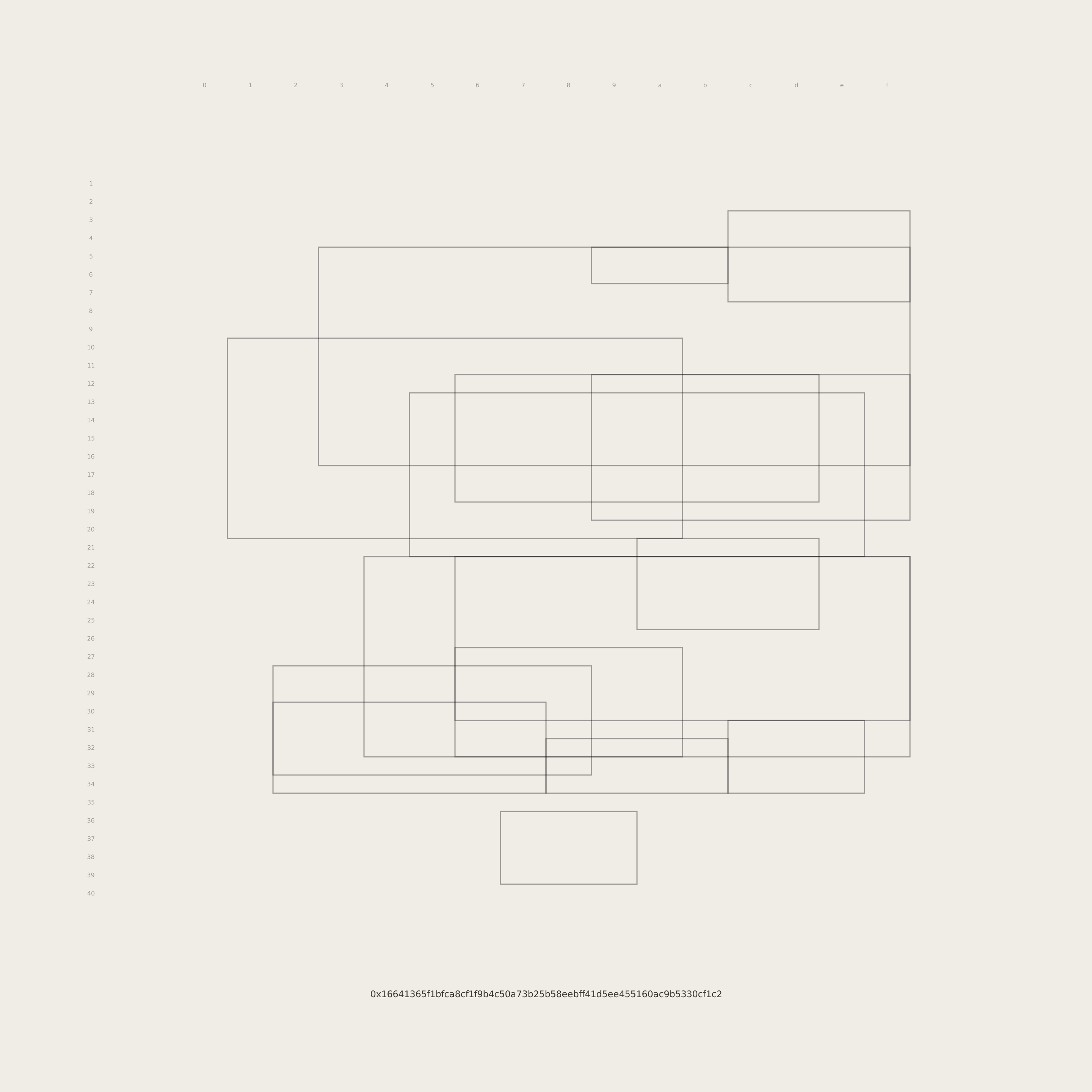
the visual output is an svg. each collector’s twenty-byte ethereum address is rendered as up to twenty rectangles on a shared hexadecimal grid, one per byte, with each byte’s two nibbles determining the rectangle’s geometry. the image reads as output and the overlap reflects what deterministic encoding looks like when many addresses occupy the same space, with no compositional choice imposed on top of it. any slice of the history can be rendered, whether that be all collectors at once, a single address, or any prior state, with each image acting as its own verification. you can confirm that a given address is encoded, but you cannot read it back out, making its presence clear but its identity obscured.
what “tokenless” actually means
the absence of a token may at first appear to be a technical curiosity or a market position, but it is what the work demanded. erc-721 was built around a model of ownership that mirrors physical objects, with the contract maintaining a mapping from token ids to owner addresses, and that model made crypto art graspable to an existing market that understands object ownership. apply it to O(1) and the work breaks immediately. a token would maintain exactly the structure the proof is designed to make irrelevant, appending new records to a ledger instead of deepening the certainty of a single fact, and the accumulation logic the proof collapses would be reintroduced at the storage layer. a token here would function as an internal contradiction and calling it a competing aesthetic decision would mistake the situation entirely.
what happens instead is that by collecting, by sending 0.01 eth and waiting for the circuit to run locally, you become part of the proof. your address is in it and you become evidence, in a system where you might otherwise have been the holder of a record. a token can be transferred, sold, burned, or lost, but your participation in the O(1) proof cannot be removed, by you or anyone else, as long as the contract exists. the relationship between collector and work resembles inscription more than ownership, closer to how a signature functions than how a purchase does.
the 72-hour window operates under the same logic. an indefinitely open proof would never close, never become an artifact, only ever an accumulation, while a capped edition would reintroduce the boundedness the proof is built to dissolve. both ends of the constraint, open to anyone and closed at a fixed moment, are load-bearing. the proof’s indifference to scale only means something if the scale is sincerely unconstrained, and the proof’s fixity only means something if there is a moment at which it stops moving. the work is open because it had to be, and it closes because it had to. what could be construed as hashrunner staking out a position against the nft market is more building something where the market’s logic cannot attach without breaking the piece.
succinctness as medium
two complementary technical mechanisms sit beneath the work. the first is the commitment scheme, an append-only data structure called a merkle mountain range that treats accumulation as a series of perfectly balanced binary trees of decreasing height, combined by hashing from the right. each collector’s address is committed into the mmr at a specific position, and a membership path through the tree is logarithmic in the number of collectors, which means even as the edition grows large the path stays small. a single ethereum storage slot of 32 bytes holds the mmr root, the bytes32 commitment that certifies everything in the tree.
the second mechanism, downstream of the mmr, is the recursive zero-knowledge proof implemented via ultrahonk, which wraps the verified history into a single, constant-size artifact: 461 fields, 14,752 bytes, the same size for the first collector and the ten-thousandth, and verifying in constant time onchain regardless of depth. the proof runs roughly 460 times larger than what a storage slot can hold, so it is written via sstore2, a gas-efficient pattern that stores data as contract bytecode instead of in standard storage. the mmr collapses the history into a single hash that fits in a single slot, the zk proof certifies that history at constant size and constant verification cost, and both express the same underlying property. that is the O(1).
it is tempting to call what this does compression, and the temptation is wrong. compression in the shannon sense is the elimination of redundancy, meaning lossless coding removes what is unnecessary while preserving what is essential, and the compressed form is smaller because something was discarded. succinctness, the property zero-knowledge proofs actually have, is different in kind. the recursive proof in O(1) discards nothing, as it certifies the entire computation without losing a single detail, and the full history remains recoverable at any depth, which is exactly why the rendering modes exist. you can call up the full grid, a single address, any prior state, or any slice and if the history had been compressed, some of it would be gone. because it is certified through succinctness, all of it is still there. the rendering modes are evidence of the property the work is built on.
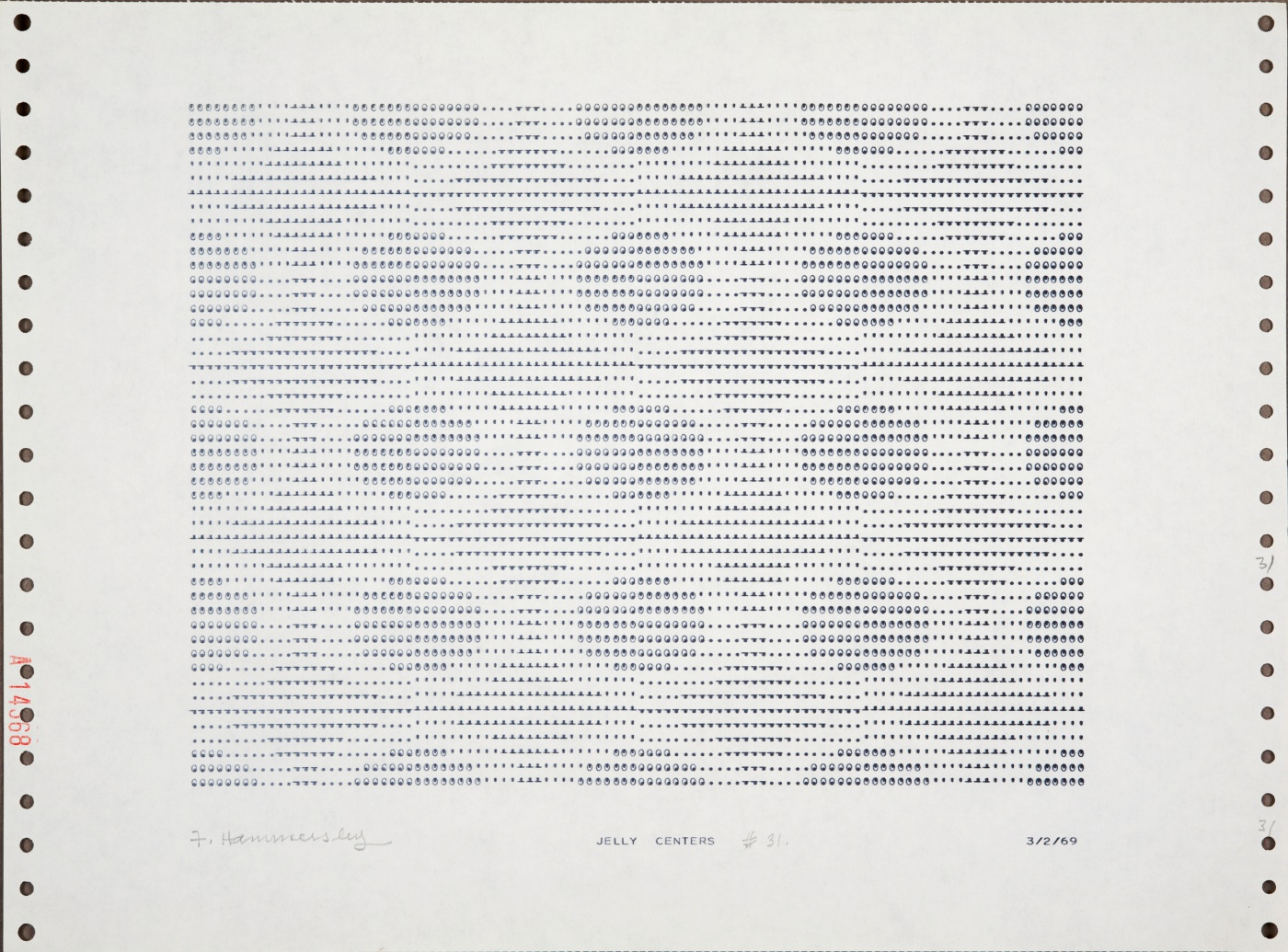
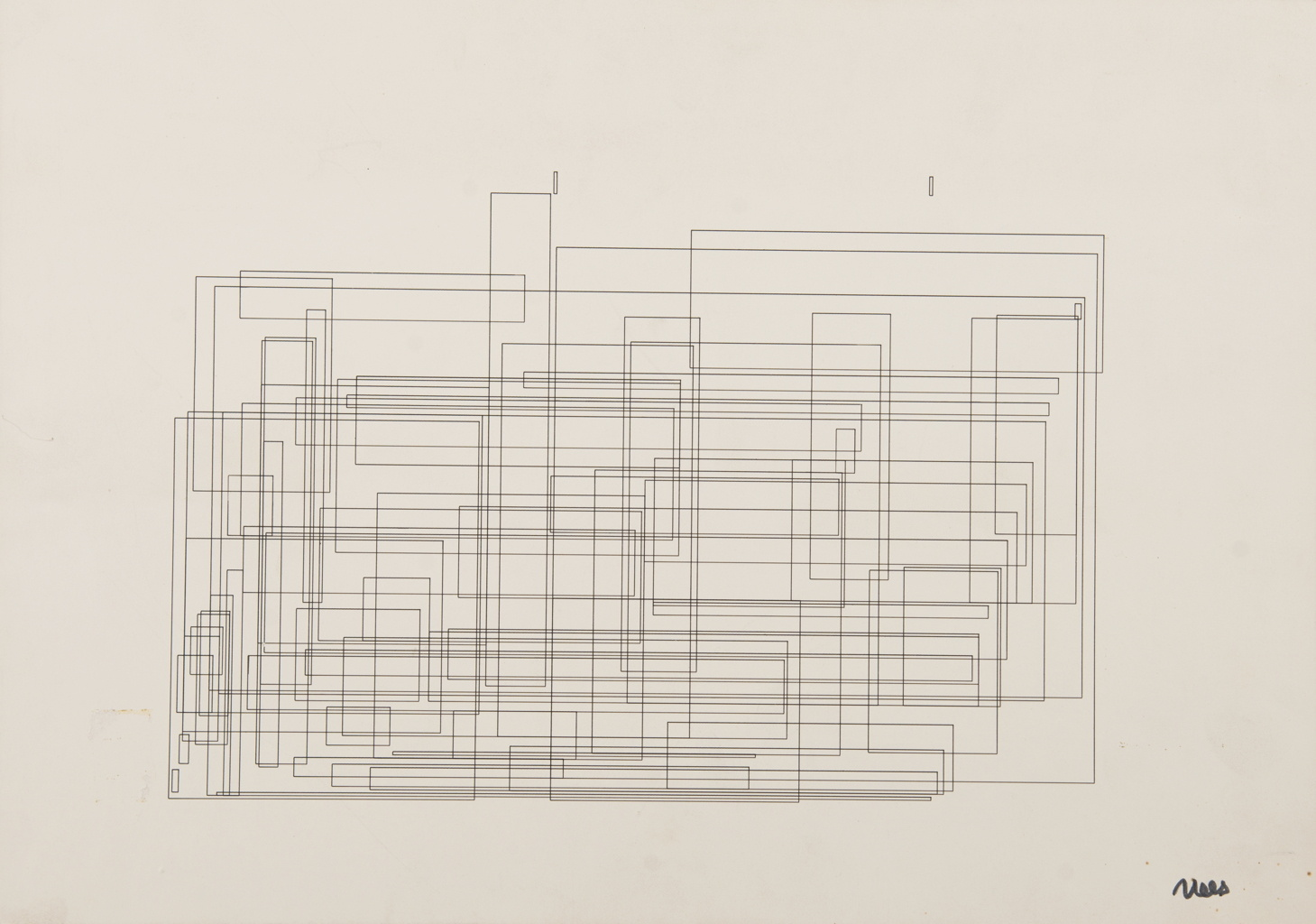
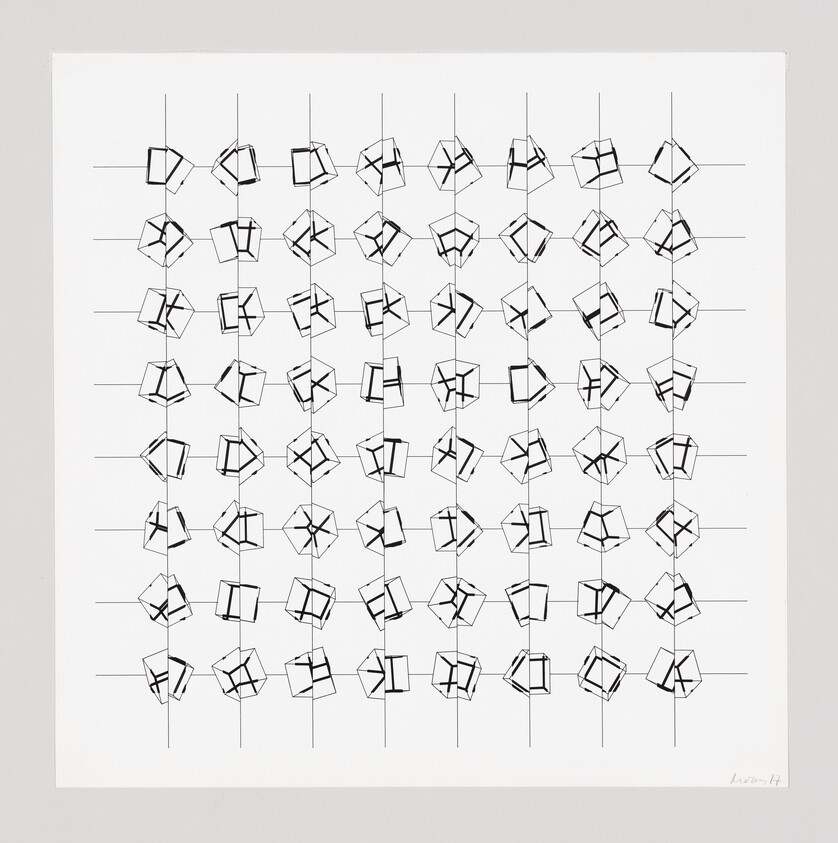
this places O(1) in a lineage and in territory that lineage could not previously reach. the early algorithmic artists shaped by max bense’s information aesthetics in the 1960s, figures like georg nees in stuttgart and manfred mohr in paris, operated in a tradition that argued beauty itself could be analyzed through information theory. mohr’s decades-long visual vocabulary of overlapping lines, grids, and rectangular projections of higher-dimensional geometry is in direct conversation with what appears on the O(1) grid, the visual logic of his early work transposed onto a system whose geometry is defined by hexadecimal address space where the cartesian coordinates once stood. what none of those artists could yet have was a way to certify what those systems had done in a manner independent of trusting the artist, the institution, or the documentation. zero-knowledge cryptography offers exactly that. the art lies in the succinctness in the gesture of demonstrating something true about a history without exposing it.
privacy that is not ethereum’s
O(1) makes a careful distinction that the privacy here is not ethereum’s. ethereum is a public ledger, and if you send 0.01 eth to the contract, that fact is public. what the zero-knowledge proof withholds is the correspondence between any specific address and the visual rendering. you can see that an address participated and you can see rectangles on the grid, but you cannot, from the image alone, determine which rectangles belong to which address, because the encoding is verifiable from the inside but unrecoverable from the outside. this is privacy understood as a property of representation; it has nothing to do with access. the image knows who is in it, the viewer does not.
there is something here of ad reinhardt, a connection hashrunner pointed me toward. reinhardt spent the years between 1953 and his death in 1967 painting what he called “the last paintings anyone can paint”, square canvases divided into subtle cruciform structures where zones of slightly different blacks create an image that only fully appears after sustained patient looking. reinhardt withheld through physical occlusion, the painting layered into illegibility through paint, where O(1) withholds through commitment, the address encoded into illegibility through cryptography. the philosophical position is the same, as the work knows more than it will say, and that constraint operates as the work’s core meaning, far from any reading of it as a limitation. there is also something in reinhardt’s insistence on art-as-art, his refusal to allow the painting to be about anything outside itself, that resonates with how O(1) lets its format bend entirely to its own internal logic. the tokenlessness, the open edition, the timed window, the single-slot commitment, none of these are concessions to a market structure that the work then operates inside of. they are what the proof required to remain itself, a format dictated from inside and never negotiated with the outside. in O(1), the protocol is the subject and the proof is the painting.
most systems of record treat inclusion as disclosure in which to be in the record is to be readable from the record, but O(1) breaks this assumption. the record includes you, the record withholds you, and once you have seen these separated, the conventional collapse of one into the other starts to look less inevitable than it did.
protocol art’s unresolvedness
most of what gets called “onchain” or “generative” art today uses the chain as gallery and random seed, with provenance verified onchain, ownership registered there, perhaps a hash of the transaction fed into a generative algorithm, but the image itself computed off-chain. this is generative art in the art blocks sense, a tradition with its own history, its own conventions, and its own accomplishments. it stands on its own and does not need to be defended against.
protocol art is a different lineage that emerged to name something the generative tradition could not quite describe. this involves works that compute onchain at runtime, where solidity is a compositional medium, where the chain functions as the very substance of the work and any recording role is downstream of that. terraforms, world computer sculpture garden, hashrunner’s own rifts and art0x1, these are works whose existence depends on the protocol running them, where the evm does the compositional work in real time, where the chain’s properties are constitutive of the artistic content itself, far past anything incidental. the vocabulary for this kind of work is still settling. even within the niche, “runtime art” and “protocol art” are used in overlapping ways, and the boundary with onchain generative art is contested. with that said, none of this is a problem to be resolved here.
O(1) sits inside the protocol art lineage and pushes it somewhere it has yet to reach. the zk proof is the work’s central material, the thing that determines what the work is, what it can do, and what it means to participate in it. remove the proof and you do not have a simpler version of O(1), you have nothing. the fluency required to encounter the work on its own terms goes beyond the art-historical and beyond the crypto-native, it also requires enough cryptographic literacy to understand why a recursive zk proof is structurally different from a standard merkle proof or a simple hash commitment. this describes the work’s ambition and its audience as hashrunner has never been trying to reach everyone, he has simply been trying to be precise for people who will notice.
there is a strain of thinking in the runtime art scene, articulated most consistently by the artist 113, co-founder of mathcastles and one of the architects behind terraforms, that computing has yet to really happen, that we are still living in something like the stone age of what the technology will eventually mean, and that one of the responsibilities of artists working in this moment is to give the world new ways of seeing what computation is and what it can be. O(1) is informed by that disposition, and it is also, in its own quiet way, a demonstration of it. zero-knowledge is most often introduced to a general audience as a privacy technology. the properties it actually has reach further than that. succinctness, the fact that a proof can certify an arbitrarily deep computation at a fixed size and a fixed verification cost, is one of the more strange and consequential properties any cryptographic primitive has produced, and most people will rarely encounter it in a way that lets them feel it. the single slot and the constant-size proof, the rendering that exists only because verification has passed, these are what constitute the visual idea. the work is teaching the eye what a property looks like when it is taken seriously as material. that is a small thing to do, and it is also exactly the kind of small thing a serious artistic intervention in a young medium ought to be doing.

the question is no longer whether computational systems can be artistic material, that question was answered decades ago. the question now is what the particular properties of this generation of systems, public verifiability and irreversibility and succinct commitment and zero-knowledge demonstration, make possible that was previously unreachable. O(1) is a careful answer to that question. the edition is open, the proof is indifferent to scale, and every image is a verification. one fact, asymmetrically known and arbitrarily deep. O(1).